Who am I? – Of Relationship and Responsibility

Image result for overcomer movie who am i

Sunday morning, my pastor preached a fantastic sermon titled, “Relationship Comes with Responsibility.” You can listen to it online here:

Then, Tuesday night, I saw the new movie, “Overcomer.” The main character in the movie is a basketball coach and history teacher at his local Christian high school. Without giving too much away, he realizes that he is finding his identity in his job, rather than in his relationship with Christ.  The other main character, a teenage girl named Hannah, is amazed when she learns who she is in Christ while reading Ephesians 1-2 in the Bible. Hannah realizes that as a child of God, she is loved, redeemed and forgiven.

So … What about ME? Who am I … and how, then, should I live?

  • I am a created being, created in the image of God, on purpose, for a purpose … so I should live daily with purpose and hope.
  • I am a disciple of Jesus, called to make more disciples of Jesus … so I should intentionally study God’s Word and share the gospel with others.
  • I am a forgiven and redeemed child of God … so I should forgive others and help them to be reconciled with God, too.

But, my relationship with God is not my only role in life. God has given other relationships, roles and responsibilities as well.

  • I am a wife … so my husband should be a priority in my life.
  • I am a homemaker … so I should clean my house and cook dinner for my family.
  • I am a mother … so I should love and disciple my children with diligence.
  • I am a homeschooler … so I should faithfully teach and train my children in the way they should go.

Like many Christians, I can tend to overemphasize one area of my life and overlook another one.

Yes, indeed, my identity is found in Christ.

  • Who am I? I am a forgiven child of God.
  • Who am I? I am His workmanship, created on purpose for a purpose.
  • Who am I? I am a disciple of Jesus, called to make more disciples.

But, I am also a wife, homemaker, mother and homeschooler to the glory of God. These titles, too, have value and worth.

May everything I do be done to the praise of God who created me, saved me, and redeemed me … and gave me a home and a husband and children.

Having a Gluten-Free Child as a Homeschooling Mom

Do any of you love food? When you’re having a bad day, do you want to head for the pantry? When you want to celebrate, do you head for your local ice cream shop? My answers are: yes, yes, yes – How about you?

In the fall of 2015, when my middle daughter was 12, she was diagnosed with an autoimmune thyroid condition called, “Hashimoto’s Thyroiditis” and began a gluten-free, dairy-limited lifestyle. This year she was diagnosed with autoimmune urticaria (chronic hives). My husband, too, has an autoimmune condition called, “Eosinophilic Esophagitis,” which he chooses to manage with acid reducers and allergy medicine. In May of 2016, I tried a modified diet called “Whole 30,” but have largely returned to regular eating except with less sugar and grains. You can read more about it here: Matthew 4:4 – Not Bread Alone and here: My Whole30 Tips

I hope I can help others with some of the lessons I’ve learned over the past four years of trial and error.

1. Don’t overlook the emotional impact that dietary restrictions have on your child. Food is a big part of our culture, and eating gluten free has consequences deeper than just bringing our own desserts when we go to potlucks. Noelle misses the food that she’s no longer able to eat, but she also hates being “the one” who needs gluten free pizza or who can’t eat Taco Bell tacos.

2. Plan for breakfast, lunch and snacks. Fresh fruit and fruit cups are great. So are guacamole with tortilla chips. Make extra dinner for leftovers that you can package in individual tupperwares for breakfast or lunch meals. Keep yogurt and deli meat on hand for a quick pick-me-up.

3. Encourage your child to get creative in the kitchen. Noelle has learned to make all kinds of creative dishes for herself. We have a weekly “cooking competition” for lunch. Some of her experiments have turned out GREAT and become regular favorites (crustless peach pie with a chocolate chip granola topping and chocolate dipped bananas to name a few).

4. Let your child make some of their own choices. Honestly, it would probably be better for Noelle if she didn’t eat any dairy or eggs or nuts, but until she’s ready to make that jump for herself, that is one battle that I’m not going to fight. It’s too hard for her, and, frankly, it’s too hard for me. Noelle knows how to add things to my “Walmart Grocery app” and she’ll add a gluten-free cookie that she’s craving or a salad bowl that she’d like to have for lunch. This allows her to have some control over her diet that she can’t have in other ways.

5. Be careful with your substitutions. In my attempts to avoid dairy, I substituted almond or cashew milk. In my attempts to avoid peanut butter, I substituted almond or cashew butter. In my attempts to avoid wheat flour, I substituted almond flour. In my attempts to avoid sugary snacks, I substituted roasted almonds or cashews. Bad idea. 😦 Noelle developed a sensitivity to almonds and cashews from eating them everyday, several times a day. Rotate your food choices.

6. Pray for understanding friends for your child. Incredibly, God has blessed Noelle with her own little group of “gluten-free friends.” For as much as she hates being different, I’m so thankful that she’s not alone in this. She isn’t the only one at youth group who can’t eat the regular retreat food.

Would you like to see my list of regular dinner meals?

How about my recipes for the BEST chocolate chip cookies (made with almond flour), or DELICIOUS banana chocolate chip muffins (made with Pamela’s baking mix)?

Exegesis or Eisegesis – in relationships???

Image result for exegesis or eisegesis

I hope y’all will bear with me for a minute while I think through something in writing. Do any of you think better in writing, too?

My pastor has tried several times to explain the difference between the biblical interpretation terms, “exegesis” and “eisegesis.” (Maybe these words are new to you — they were to me!) Exegesis involves looking deeply into the text to discover what God is communicating to us, while eisegesis involves bringing our own ideas to the Bible and then looking for evidence to support it. My pastor has often warned us not to have an idea that “seems right” to us and then dig a verse out of context to “prove it.” For example, using “I can do all things through Christ who gives me strength” to justify a whole laundry list of activities might be an example of “eisegesis.”

Last week, I started thinking about how I can be guilty of “eisegesis” in my relationships. I can let my own ideas and biases color how I interpret my loved one’s actions.

Let’s say, I’m feeling neglected and unloved by my husband, and he fails to let me know that he’s going to be late getting home from work. The thoughts in my head go something like this: “He’s so thoughtless. He doesn’t care about my feelings one bit. He always acts like this.”

But, if my love-cup is full and I’m feeling like my husband adores me, then when he fails to let me know that he’s going to be late getting home from work, I think, “Poor guy. He must be caught in the middle of a long phone call at work. I should shoot him a quick text to see how he’s doing.”

How about if I’m feeling like my daughter doesn’t like me. Envy quickly rears its ugly head and I start blaming my ugly feelings on her. When she tells me about a long conversation she had with a friend of hers, my mind starts whirling. “She always makes time for other people in her life, but never seems to have time for me. She is so inconsiderate … and after all I’ve done for her.”

But, if we’ve been spending regular sweet time together, then my thoughts take a totally different spin. Instead I think, “Thank you, Father, for giving Emily such a good friend that she can do life with. Thank you for answering my prayers. I am so blessed!”

Here’s the thing: truth is truth, and feelings are feelings. But feelings should never be the basis for truth. We have to carefully test our feelings in light of the truth. Our feelings change moment by moment, but truth remains the same.

We should approach both the scriptures, and our relationships, with what is true. The truth is that our battle isn’t against flesh and blood. The truth is that we should carefully renew our minds in light of the truth.

The truth is that God loves me and has good plans for me.

The truth is that God is sovereign and at work even in hard situations.

The truth is that my husband loves me, my children love me and I love my husband and my children.

The truth is that I am a sinner saved by God’s grace and I am prone to think selfish thoughts.

The truth is that love is patient and kind. It does not envy or boast. It is not proud or rude. And God wants me to pour out His love on others.

The truth is that God loved me while I was still a sinner, so as the chief of sinners, I can love others with the love God has lavished on me.

How do you need to remind yourself of what is true and discern rightly the relationships you’re in? I’d love to hear your thoughts.

Witnesses for Jesus

This week as I’m reading through John chapter 5:30-40, I noticed the words “witness” and “testimony” over and over again.

“I [Jesus] can do nothing on my own. As I hear, I judge, and my judgment is just, because I seek not my own will but the will of him who sent me. If I alone bear witness about myself, my testimony is not true. There is another who bears witness about me, and I know that the testimony that he bears about me is true. You sent to John, and he has borne witness to the truth. Not that the testimony that I receive is from man, but I say these things so that you may be saved. He was a burning and shining lamp, and you were willing to rejoice for a while in his light. But the testimony that I have is greater than that of John. For the works that the Father has given me to accomplish, the very works that I am doing, bear witness about me that the Father has sent me. And the Father who sent me has himself borne witness about me. His voice you have never heard, his form you have never seen, and you do not have his word abiding in you, for you do not believe the one whom he has sent. You search the Scriptures because you think that in them you have eternal life; and it is they that bear witness about me, yet you refuse to come to me that you may have life. (John 5:30-40 ESV)

When a word or idea is used repeatedly, it catches my attention. In looking on my Blue Letter Bible app, I easily discovered that both the noun and verb here have the same root from where we get our English word, “martyr.” [“martyreo” (verb), means: “to bear witness, i.e. to affirm that one has seen or heard or experienced something, or that he knows it because taught by divine revelation or inspiration, while “martyria” (noun) means “what one testifies, testimony, i.e., before a judge.”]

In looking again at this passage, I notice that Jesus admits that if He alone bore witness about Himself, then we wouldn’t be expected to trust Him. (John 5:31)

This reminds me of a recent comment by a parent of one of my VIPKID students. She said that she couldn’t trust a teacher’s own biographical comments, because they said it about themselves. Rather, she wants to read comments by other parents who have taken classes with that teacher.

She wants to hear the testimony of other witnesses because it’s hard for her to trust an unknown teacher’s self-proclaimed praise.

God knew that people would feel this way. In fact, we ought to doubt people who sing their own praise. So, in God’s great mercy, He provided four additional witnesses about Jesus.

  • John the baptizer bore witness about Jesus. (John 5:33)
  • Jesus’s works bore witness about Jesus. (John 5:36)
  • God the Father bore witness about Jesus. (John 5:37)
  • The Scriptures bore witness about Jesus. (John 5:39)

But now, let’s look at an additional witness about Jesus that God has prepared: His followers. Look with me at Acts 1:8

“But you will receive power when the Holy Spirit has come upon you, and you will be my witnesses in Jerusalem and in all Judea and Samaria, and to the end of the earth.”

God desired for the 1st century disciples of Jesus to go out as His witnesses to what they had seen with their eyes, heard with their ears, and believed with their hearts. And God desires for us as 21st century disciples of Jesus to go out as His witnesses to what we have seen with our eyes, heard with our ears and believed with our hearts.

If you’d like to study this topic more, try visiting www.BlueLetterBible.org and searching for “witness*” in the New Testament. Or Click HERE – I’ve done the work for you. 🙂

If you’d like to read my own eyewitness testimony of coming to faith in Jesus, I’d love for you to get a copy of my new book, God is Real: The Eyewitness Testimony of a Former Atheist. You can buy it on Amazon in paperback or Kindle, or order it at your local bookstore.

If you’d like some help in how to share your testimony, I’d love to help you! Leave me a comment below.

Take It Away

This week I’ve been reading through the book of John. Each chapter I ask 4 questions: What do I learn about God? What do I learn about man? Are there any sins to avoid? Are there any examples or commands to follow? I also choose one verse (or more) to write down and study more. On Thursday, I chose John 1:29, where John the Baptizer sees Jesus coming and exclaims, “Behold, the Lamb of God, who takes away the sin of the world!”

In studying this verse I gained a deeper understanding of what Jesus taking away the sins of the world really means. In my mind, Jesus “taking away” the world’s sins looked a lot like a waiter “taking away” my dirty dishes after I’d finished eating, or “taking away” a particular cold soup that didn’t meet with my approval. Or maybe even like a judge commanding the bailiff to “take away” an unruly prisoner.

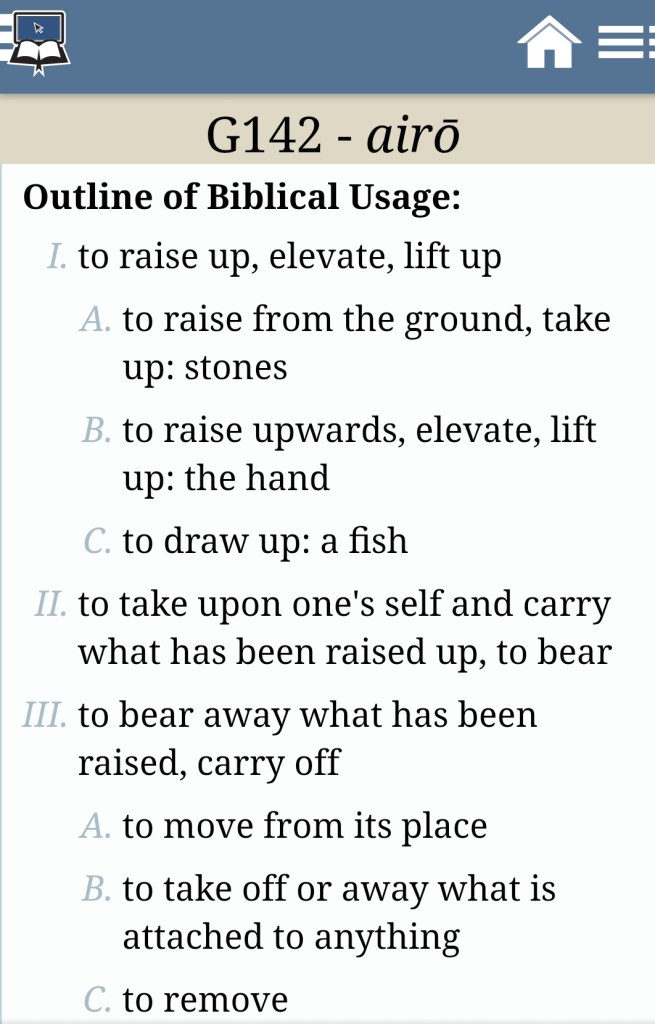
Instead, this verse uses the Greek word, “airo” (“take upon one’s self and carry what has been raised up, to bear”) which is also found in Matthew 11:29, where I’m told to take Jesus’s yoke upon myself, and Matthew 27:32 where Simon of Cyrene was compelled to carry Jesus’s cross. Jesus Himself uses this word in John 5:8, where he tells the invalid to “take up your bed and walk.”

Jesus did more than “send our sins away.”

Jesus didn’t just “throw our sins in the trash” or tell someone else to “take our sins away.”

Jesus, the Lamb of God, “took our sins away” Himself. He bore our sins in our place, taking them upon Himself on the cross.

“When you were dead in your transgressions and the uncircumcision of your flesh, He made you alive together with Him, having forgiven us all our transgressions, having canceled out the certificate of debt consisting of decrees against us, which was hostile to us; and He has taken it out of the way, having nailed it to the cross.” Colossians 2:13-14 (NASB)

Please join me in praising God anew for sending Jesus to take away your sin through faith in His only Son.

“For the wages of sin is death, but the free gift of God is eternal life in Christ Jesus our Lord.” – Romans 6:23 ESV

“God shows his love for us in that while we were still sinners, Christ died for us.” – Romans 5:8 ESV

“Thanks be to God for his inexpressible gift!” – 2 Corinthians 9:15 ESV

Can I See It?

On Monday, while our Chinese friends were visiting, my son, Daniel, said, “Can I see that toy?” to 9-year-old Hao Xuan whose English name is Hudson. Hudson proceeded to show Daniel the toy, not realizing that what Daniel really wanted was to be given the toy. Daniel didn’t want to just “see it.” He wanted to hold it.

I then explained to Hudson that the phrase “Can I see it?” actually means, “Can I have it for a little while?” Isn’t English so confusing sometimes?

The next day, I was rereading the July 7 entry from New Morning Mercies, a devotional book by Paul David Tripp. This entry about “Hope” had been given to everyone in our 1 Peter study class shortly before my trip to China. I especially loved it because (1) Hope is my 2019 “word of the year,” and (2) I love repeated numbers like 7/7.

Tripp writes:

“Gospel hope is a mouthful. It includes so many wonderful provisions that it’s hard to get it all in one bite. Yes, biblical hope gives you a lot of spiritual nutrients to chew on. Yet, many believers seem to live hope-deprived lives.”

“Perhaps one of the dirty secrets of the church is how much we do out of fear and not faith. We permit ourselves to feel small, unable, alone, unprepared and bereft of resources. We tell ourselves that what we’re facing is too big and requires too much of us. We stand at the bottom of mountains of trouble and give up before we’ve taken the first step of the climb. We wait for hope to come in some noticeable, seeable way, but it never seems to arrive…. We wonder, “where is hope to be found?”

“What we fail to understand is that we don’t have a hope problem; we have a sight problem…. Hope isn’t first a set of circumstances. Hope isn’t first a set of ideas. Hope is a person and his name is Jesus. He came to earth to face what you face and to defeat what defeats you so that you would have hope.”

“You have hope because he exists and is your Savior. You don’t have a hope problem; you have been given hope that is both real and constant. The issue is whether you see it.”

“Paul captures the problem this way in Ephesians 1:18-19, “… having the eyes of your hearts enlightened, that you may know what is the hope to which he has called you, what are the riches of his glorious inheritance in the saints, and what is the immeasurable greatness of his power toward us who believe, according to the working of his great might.”

“Paul prays that we will have a well-working spiritual vision system so that we will “see” the hope that we have been given in Christ. What is this hope? It is a rich inheritance. Jesus died and left us a rich inheritance of grace to be invested in facing the troubles of the here and now. It is great power that is ours in the moments when we are so weak. Hope came, and he brought with him riches and power that he gave to you. You see, you don’t really have a hope problem; you have a vision problem, and for that there’s enlightening grace.

I want to both see hope with my eyes and hold hope with my soul. I want to experience God’s hope first-hand, being an eyewitness to His immeasurable greatness at work in my life and believing what He has already spoken in His Word.

Please join me in praying that we would “have the eyes of our hearts enlightened,” and that we would “hold fast the confession of our hope without wavering, for he who promised is faithful.” (Hebrews 10:23)

We can trust God to answer our prayers for hope. When we ask our Heavenly Father, “Can I see it?” He will both let us see hope with our eyes and hold it fast with our souls.

The God of Purpose

Before believing in God, I thought life was a series of random, chance events. I’m sure most people would expect atheists to see life this way. But I am concerned by how many Christians are still living with this same worldview. All too often we are still looking at life through glasses that say, “Everything in life is luck,” as credited to President Donald Trump.

This morning, while reading Ephesians 1, I was impressed by how many words of “intentionality” are used. God blessed us. God chose us. God predestined us according to the purpose of His will. God works all things according to the counsel of His will.

If you find yourself going through a struggle today, remind yourself that God has a will and a purpose. Tell your own soul that God is always at work even when you can’t see Him. Choose to believe the truth that life is not “all about luck.”

– TWIG

“Blessed be the God and Father of our Lord Jesus Christ, who has blessed us in Christ with every spiritual blessing in the heavenly places, even as he chose us in him before the foundation of the world, that we should be holy and blameless before him. In love he predestined us for adoption to himself as sons through Jesus Christ, according to the purpose of his will, to the praise of his glorious grace, with which he has blessed us in the Beloved. In him we have redemption through his blood, the forgiveness of our trespasses, according to the riches of his grace, which he lavished upon us, in all wisdom and insight making known to us the mystery of his will, according to his purpose, which he set forth in Christ as a plan for the fullness of time, to unite all things in him, things in heaven and things on earth. In him we have obtained an inheritance, having been predestined according to the purpose of him who works all things according to the counsel of his will, so that we who were the first to hope in Christ might be to the praise of his glory.” – Ephesians 1:3-12 ESV

“Blessed be the God and Father of our Lord Jesus Christ! According to his great mercy, he has caused us to be born again to a living hope through the resurrection of Jesus Christ from the dead, to an inheritance that is imperishable, undefiled, and unfading, kept in heaven for you, who by God’s power are being guarded through faith for a salvation ready to be revealed in the last time. In this you rejoice, though now for a little while, if necessary, you have been grieved by various trials, so that the tested genuineness of your faith–more precious than gold that perishes though it is tested by fire–may be found to result in praise and glory and honor at the revelation of Jesus Christ.” – 1 Peter 1:3-7 ESV

The Testing of my Faith

When I was an atheist, I thought Christianity was primarily a system of rules for good behavior. To me, Christianity was mostly about going to church and reading the Bible and not cussing or sleeping around. And I’m afraid that I thought that because so many of the Christians I met thought that.

Now, I understand that Christianity is actually a religion of faith, believing that God exists and that He rewards those who seek Him, believing that Jesus Christ is Almighty God taking on human flesh and dying in my place, believing that the Holy Spirit really does live in me and guide me in all truth. And this faith leads me to obey God and follow the rules that He has laid out in the scriptures, trusting that these rules are for my good and ultimately for the glory of God who made me and cares for me.

But, my Christian faith doesn’t stop at just believing in the triune God and His revealed Word.

My Christian faith leads me to follow God wherever He leads me, even if that means a trip halfway around the world to stay with people that I’ve never met before (or even spoken with over the phone).

A year and a half ago, I started teaching English online to students in China. This led to chatting online with several of my students’ mothers. This led to having a new Chinese “little sister,” a 30-something nurse with one elementary-school-aged son. This led to ever-deepening conversations about parenting and patience and life as a working wife and mother. This led to a presentation of the good news of salvation through faith in Jesus which led to a new life in Christ for someone who (for all intents and purposes) was still a stranger to me.

When my husband and I began considering a visit to China, my heart was cold toward all things “vacation related.” I dreaded the flight and the jet lag. I dreaded the crowds of people and the air pollution. I dreaded sore feet and sickness. I dreaded chicken feet and pig ears.

And yet, I had God’s perfect peace and genuine excitement about this step of faith. I wholeheartedly believed that God had opened this door for us and that we were supposed to walk through it. I truly wanted for my little sister’s good. Even if all of the circumstances truly were as bad as I feared, I still wanted to go because I knew it was what God wanted me to do.

So we went.

In so many ways, our trip to China was exactly what I expected. But in so many other ways, it was nothing like I expected. The flight was long and the crowds were horrible. My feet were sore and the pig ears were gross. Communication difficulties were real and we weren’t able to chat as much as I wished. (Did I mention that my Chinese sister and I communicate through translation software?)

But, through it all, God has grown my faith. God has shown me that He is unquestionably the sovereign sustainer of my life. He is the lifter of my head. He is the giver of every good gift. He is my refuge and strength.

God sees me in China and God sees my children back home. God loves the people of China and God loves me. And I’d do it all again.

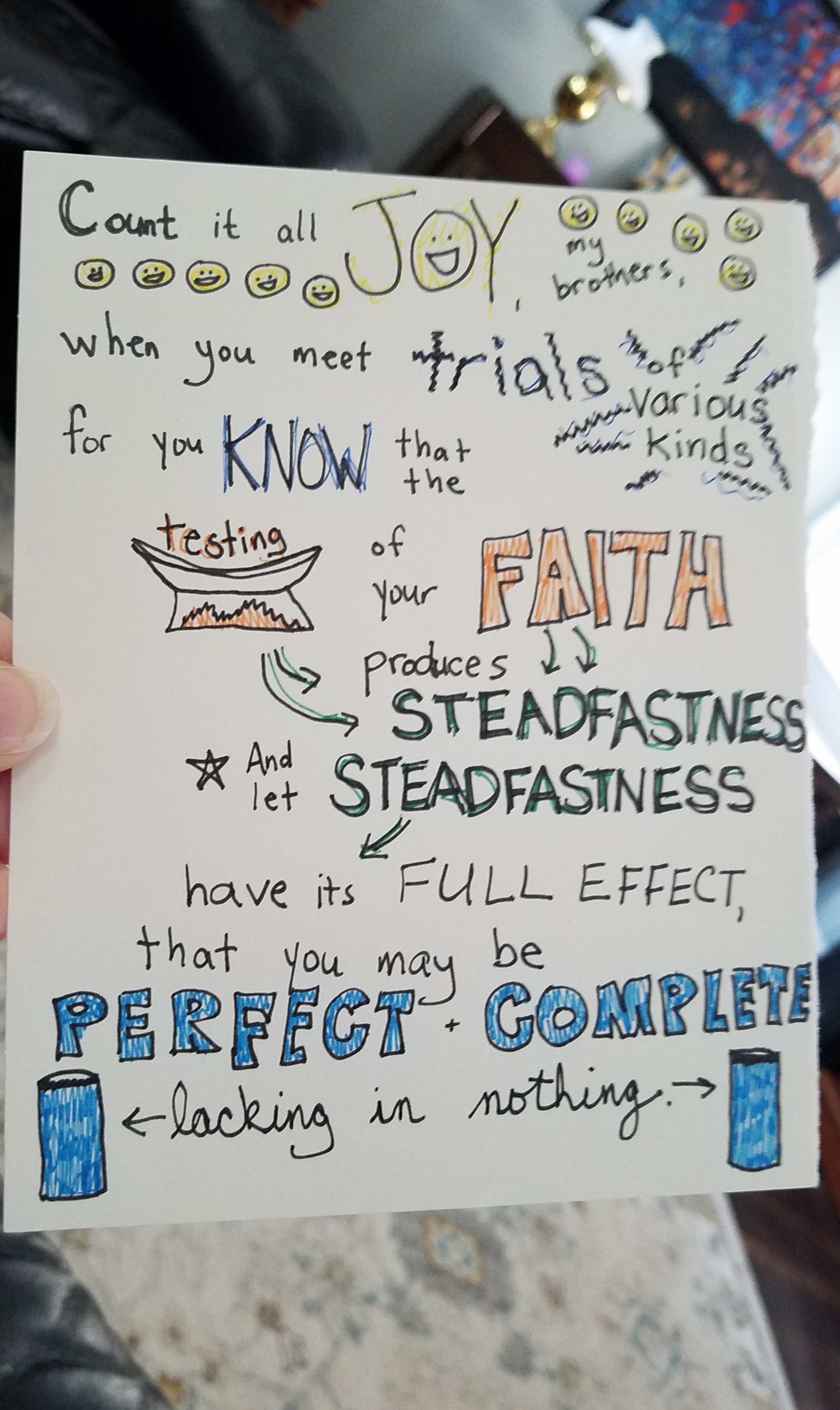
So, this morning as I was working on a passage I’m memorizing, “Count it all joy, my brothers, when you meet trials of various kinds, for you know that the testing of your faith produces steadfastness. And let steadfastness have its full effect, that you may be perfect and complete, lacking in nothing.” James 1:2-4, I saw how sometimes the testing of my faith isn’t just in going through cancer or baby loss or difficult parenting situations. Sometimes the testing of my faith means to take that next step of faith, like starting a new job or flying to China. This time I think testing of my faith looked more like Abraham who “obeyed when he was called to go out to a place that he was to receive as an inheritance. And he went out, not knowing where he was going.” (Hebrews 11:8)

Is there something God is calling you to do that feels scary? How is God growing your faith as you step out into the unknown, being daughters of Sarah, choosing to “not fear anything that is frightening?” (1 Peter 3:6b) I’d love to walk this road with you. How can I pray for you?

I’d love to walk this road with you. How can I pray for you?

God made sloths, elephants, and YOU

Today at lunch time, I was reading a new devotional book with my kids. It mentioned how creative God is and how He created all different kinds of unbelievable animals.

If you’re like me, you, too, love the incredible variety of animals in our world and find it fascinating how different they all are.

But, have you ever thought about why people don’t want to all be different? As humans, we all want to be like everybody else! We think we should all be tall and thin and have the intellect of a genius. None of us want to be a slow-moving sloth or an enormous elephant.

Friends, God has a purpose for the sloth and for the elephant. God has a purpose for every, single human being that He creates, no matter their physical appearance or mental ability. God has a purpose for YOU.

Are you feeling unnecessary, unimportant or not good enough?

GOD, the Creator of the Universe, made YOU. That’s enough for you to be necessary, important and valuable.

How can I pray for you today?

How can you encourage someone else today? Pass it on!

Expectations

After returning home from spending a week caring for my dad in the hospital, I’ve been wondering, Why is it so much easier for me to love and serve my dad than my husband? I understand that this may never have been a struggle for you, but for me, it requires a conscious, daily choice to put my own selfish wishes aside to love my husband. Why is that? I may have finally found the answer … or at least one answer.

I expect nothing from my dad except for the most basic level of kindness.

I expect him to remember my birthday with a phone call and a gift (and to be honest I bet even that comes from my mom). I expect my dad to be happy to see me and to enjoy the few days a year we’re able to spend together.

Yep. That’s about it. Done. Expectations met.

Now, let’s see, what do I expect from my husband? Are you ready? This may be a little longer.

1. I expect him to notice when I need some help, picking up the slack when I’m busy with kids or errands or Bible study or even fun time with my friends.

2. I expect him to care about how I’m feeling, asking questions about how I’m doing and listening attentively.

3. I expect him to express his love for me with hand-written notes or flowers on random occasions, and to go “all out” for Mother’s Day and my birthday.

4. I expect him to know what I would want to order at my favorite restaurants … and to know what restaurants I’d want to go to for a regularly scheduled date night away that he has planned.

5. I expect him to tell me how beautiful, smart, funny, and all-around fantastic I am and that no one could ever take my place.

6. I expect him to express gratitude for all the little things I do at home, cooking meals, cleaning up, caring for our kids.

7. I expect him to have his own daily quiet time with God, and to share his Biblical insights with me, praying for me and with me, and to lead our children in their faith in God.

8. I expect him to take care of his physical body, exercising on occasion, eating somewhat well, using sunscreen, going to the doctor and taking whatever medicine he needs.

9. I expect him to be interested in our children, asking about their day and listening attentively, giving discipline, counsel or encouragement where appropriate.

10. I expect him to encourage me to spend time with my family and friends, as well as attend two women’s retreats a year and have an overnight away for some alone time.

11. I expect him to take care of all the “manly jobs” around the house: mowing the lawn, changing lightbulbs (he’s 10 inches taller than me!), as well as minor wood, electrical and plumbing work, home improvement projects and the like.

Well, that about takes care of it. ?

Honestly, I don’t think these expectations are unfair for a wife to have of her husband, but the point is this: The reason it is easy for me to just love my dad right where he is, is because I’m not constantly frustrated that he’s falling short of my expectations for him.

Ultimately, God is the only one able to meet all of my needs … and the only one able to change my husband. I have to choose to focus on my own walk with God and my own shortcomings, rather than my husband’s, and that is HARD TO DO!

Hope this encourages y’all, like it’s encouraged me!

What expectations do you have of your dad or husband that I left off my list?